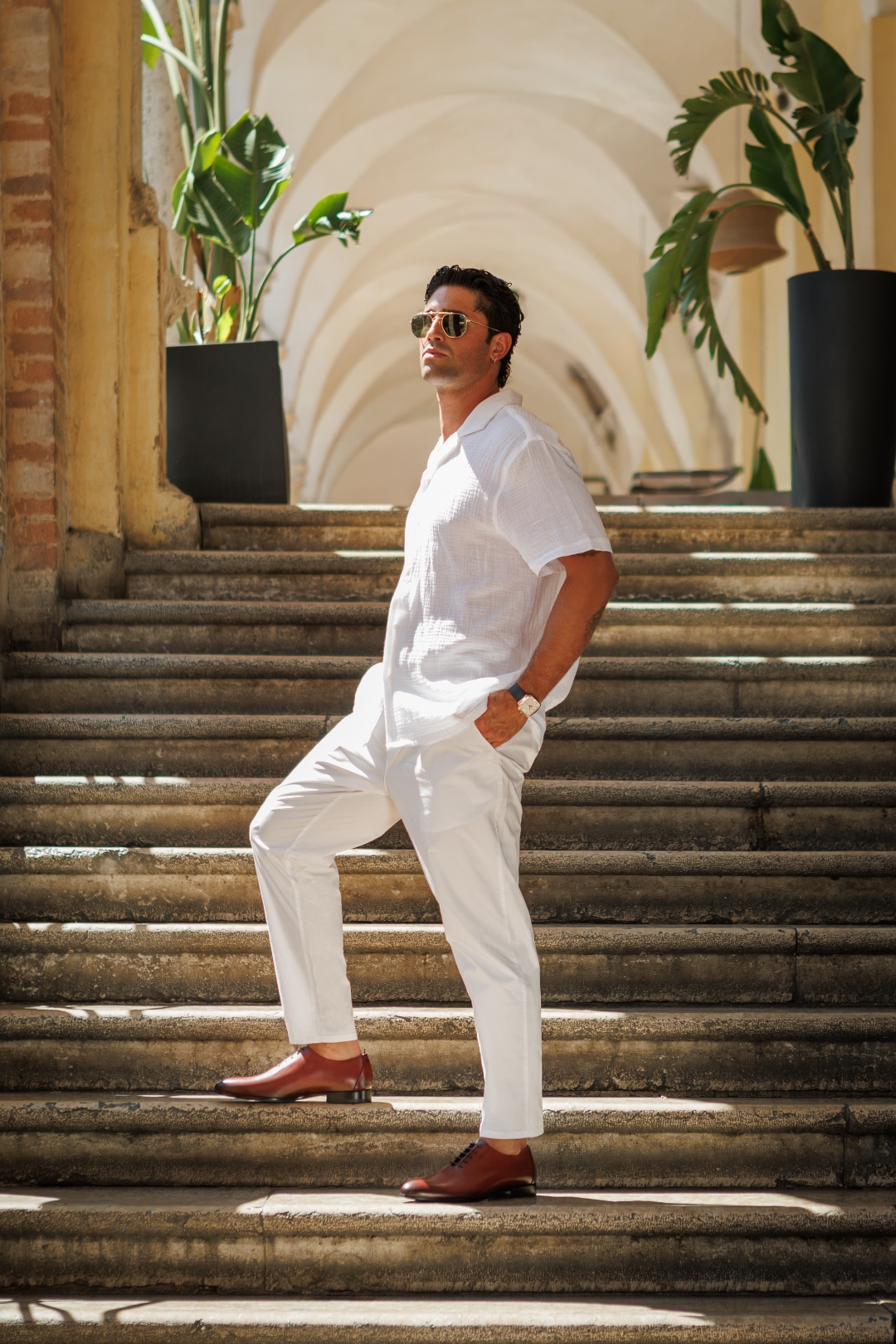
Among the hierarchy of men's dress shoes, one construction stands above the rest in both scarcity and skill: the whole-cut Oxford. It is a shoe with no side seams, no panels, no pieced-together sections of leather, just a single, continuous piece of hide folded and shaped around the last to form the entire upper. Ask any shoemaker which style tests their craft most severely, and the answer is almost always the same. The whole-cut is the purest expression of the art, and it is unforgiving of error.
A Single Piece of Leather, No Room for Mistakes
Most Oxford shoes are built from several pieces of leather, a vamp, quarters, and toe cap or wingtip overlay, stitched together at defined seams. A whole-cut Oxford abandons that approach entirely. The upper is cut from one unbroken section of top grain leather, then wrapped, molded, and closed with a single seam at the heel, the only seam the design allows.
This is precisely what makes the whole-cut so demanding to produce. Leather is a natural material, and every hide has its own grain, thickness, and subtle imperfections. When a shoe is assembled from multiple panels, a flaw in one section can be cut away and replaced. In a whole-cut, there is no such flexibility. The maker must select a flawless section of hide large enough to cover the entire upper, then last it with exacting precision so the leather stretches evenly across the foot without wrinkling, bubbling, or distorting at the toe and vamp. A single miscalculation and the entire piece is wasted.
Why the Whole-Cut Is Considered the Hardest Shoe to Make
Shoemakers often describe the whole-cut as the ultimate test of lasting skill, the process of stretching and shaping leather over the wooden or plastic form that gives a shoe its structure. Because there are no seams to help control tension across the upper, the leather must be pulled and manipulated by hand until it lies smooth in every direction at once. Get it wrong, and the shoe will show creasing exactly where a craftsman's inexperience shows most: across the vamp, in full view with every step.
The result, when done correctly, is a shoe of striking visual purity. Without seams to interrupt the eye, the whole-cut Oxford reads as a single, sculptural object, smooth, minimal, and unmistakably refined. It is the dress shoe equivalent of a bespoke suit cut from one bolt of cloth with no visible pattern-matching compromises.
The Francesco: Nunzio Orsini's Whole-Cut Oxford
At Nunzio Orsini, The Francesco is our whole-cut Oxford, built from a single piece of top grain Italian leather sourced and finished in the Marche region. It represents the most technically exacting shoe in our collection, a style we approach through what we call modern handmade construction: handmade by skilled artisans, with precision machine assistance used only where it improves consistency without compromising the integrity of the craft.
Every Francesco begins with the careful selection of leather sections free of the natural marks that would otherwise be invisible on a paneled shoe but glaringly obvious on a whole-cut. The upper is lasted by hand, checked repeatedly for tension and symmetry, and finished with the clean, unbroken silhouette the style demands. At $495, it sits at the accessible end of true whole-cut craftsmanship, a category that, from traditional ateliers, often commands significantly more.
The whole-cut Oxford does not hide behind seams or overlays. It succeeds or fails on the strength of the leather and the hand that shapes it.
What Occasions Call for a Whole-Cut Oxford
Because of its minimal, unbroken silhouette, the whole-cut Oxford is widely regarded as the most formal shoe a man can wear short of formal evening pumps. Its clean lines pair naturally with the gravity of black tie, and it is the traditional choice alongside a tuxedo. But its versatility extends well beyond formalwear.
- Black tie and formal evening events, the whole-cut's minimalism matches the occasion's restraint.
- Boardrooms and high-stakes meetings, a quietly commanding choice for the man who prefers substance over statement.
- Weddings, as guest or groom, refined enough for the occasion without a single distracting detail.
- Everyday tailoring, in a versatile color like the Francesco's rich maroon, it elevates a standard business suit into something considerably sharper.
How to Style a Whole-Cut Oxford
Let the shoe's simplicity do the work. Because the whole-cut carries no ornamentation, it pairs best with tailoring that shares its restraint: a well-cut suit in navy, charcoal, or mid-grey, a slim dress sock in a complementary tone, and minimal accessories. Avoid overly casual trousers or heavily textured fabrics, which compete with the shoe's clean lines rather than complement them. The whole-cut Oxford is not a shoe that needs to shout, its craftsmanship speaks for itself to anyone who knows what they are looking at.
For the man who understands that true luxury often lies in what has been removed rather than added, the whole-cut Oxford remains the definitive statement, a shoe built from one uncompromising piece of leather, and one uncompromising standard of craft.